Wednesday, 24 June 2020

AGODA – Business and Revenue Model

This post first appeared on AGODA – Business and Revenue Model
For Startup Investments check out https://www.nexea.co

This article is part of a study of popular businesses & their business and revenue models so that people can understand how investors look at startups. Examples of which can be seen in our Grab, Setel and Lazada articles. Most information are facts collected publicly, and some are our own assumptions – which are pointed out as such. In this article, we will be studying the Agoda business model and revenue model.

The hotel booking industry is a fiercely competitive one which has spawned a somewhat peculiar symbiosis between travel industry suppliers and online travel agencies (OTAs). On one hand, OTAs allow these suppliers to have an endless supply of both new and returning customers without much effort, especially after years upon years of efficiency improvements. On the other, however, this endless and effortless demand has also come at the expense of a large cost: extremely high commissions on each booking.

One of the major subindustries in the OTA industry is hotel booking. Hotel booking is the third-largest subindustry in OTA and is the third fasting growth rate based on revenue, only lagging behind Vacation Rentals and Package Holidays.

Agoda business model

One of the reasons behind such rapid growth is the fierce competition between hotel booking companies, one of which is Agoda. Agoda is one of the world’s fastest-growing online travel booking platforms, having been founded as an e-commerce start-up based in Singapore in 2005. Since then, it has grown to a massive multinational corporation which offers a massive network of 2 million properties in over 200 countries worldwide.

In the beginning, eventual co-founders Michael Kenny and Robert Rosenstein started two hotel booking websites, PlanetHoliday.com and PrecisionReservations.com, but eventually combined both companies into Agoda, as an e-commerce startup. In 2007 Agoda was acquired by Booking Holdings and now holds a subsidiary status under Booking Holdings.

Agoda Key History

  • Founded by Michael Kenny and Robert Rosenstein in 2005
  • Acquired by Booking Holdings in 2007
  • Launched in July 2011 in Apple’s App Store and Google’s Play Store
  • Acquired Qlika in 2014 to focus on pay-per-click advertising and to automate and scale marketing systems
  • Acquired WooMoo in May 2016 to focus on mobile app prototyping and working on mobile app development
  • Appeared on Google search results for the first time in May 2016
  • Started branching into non-hotel accommodations in 2017
  • Pursued greater business emphasis in Israel and Europe in April 2019
  • Worked together with Digitas to expand its reach to various Asian markets through data-driven content marketing in September 2019
  • Added the Mix and Save feature to allow customers to more conveniently book different rooms for every night of stay in October 2019
  • Started selling flights in October 2019

Agoda Key Facts and Statistics

  • Over 2.6 million properties in over 200 countries worldwide
  • Available in 38 languages on Apple’s App Store and Google’s Play Store
  • Employs more than 5,000 staff with offices in 30 countries
  • Headquartered in Singapore and a subsidiary of Booking Holdings
  • Malaysia is listed at Rank 7 in the Top Asian Countries with Most Properties on Agoda
  • Kuala Lumpur is listed as Rank 6 in the Top Cities with Most Properties on Agoda
  • Rank 1 based on confirmed room nights booked on Malaysian properties

*Note that the statistics used may be slightly dated*

Agoda business model

The Hotel Booking Business In Malaysia (& the World)

Usually in this section, we talk about the industry only from a Malaysian perspective. However, for this topic, feel that having an insight into the brief history and evolution of the global hotel booking industry will be greatly beneficial in understanding the Hotel Booking business from the Malaysian perspective.

Before the rise of the internet, hotel booking mostly involved contacting hotels through a phone-call or in-person visit to personally book hotel rooms. It was only with the rise of the Internet that the online booking business began to pick up steam. With the shift of the internet for work use to personal use, there was an explosion in interest in consumer internet. During that time, Microsoft used this explosion of interest accompanied by the dot corn bubble to create Expedia, the first-ever Online Travel Agency.

Since then, online hotel bookings have become the norm for everyday consumers, in Malaysia and all around the world. However, one can only wonder, what exactly do these online hotel booking businesses offer and what are the advantages of booking for hotels online rather than contacting hotels directly?

OTAs are online companies which allow for consumers interested in travel-related services to book directly from their websites. Their business model is based on the Marketplace Model which essentially means that they act as a third party agent which resell trips, hotels, vacation packages, etc, where the guest pays off the OTA at the lime of booking, and the OTA will only pay the hotel after the actual stay occurs.

As discussed before, this means that they benefit the hotels themselves by allowing for an endless supply of customers, without having the hotels themselves deal with the excess administrative cost incurred when dealing with customers. Furthermore, the benefits that OTAs bring to the hotel booking business is especially large to the consumers. This boils down to three core components: choice & variety, price and user experience.

In terms of choice and variety, OTAs such as Agoda allows for consumers to have all their choices in one place. This allows for an increase in information, leading to a decrease in information failure, which allows for the optimal price point, where consumers can get the best deal. This is largely due to the fact that they are able to compare prices easier on OTA websites rather than individually comparing each hotel room price. They may also have taste-based preferences which can be easier sorted on OTA websites. Hence, having a variety of different choices for hotel rooms allow for customers to gain the highest utility.

Secondly with price, as discussed before, there is a major benefit to consumers when they have all the information on a certain market. OTAs allow for this increase in access to information. Although it can be argued that consumers can compare prices from individual hotel websites, OTAs save the hassle of doing so by collecting the information themselves and, then only, listing it on their websites.

Lastly, from a user experience standpoint, OTAs have spent years upon years of optimising their websites to allow for the most consumer-friendly and accessible way of viewing and comparing different choices and their price accompaniments. This attracts customers to their website and also makes them the go-to choice when it comes to hotel bookings.

Ultimately, this means that OTAs have made the consumers in the hotel bookings market their main priority. Until today, they are still finding ways to improve the user experience, something that hotels have struggled to compete with since the digitalisation of such services in the late 1990s. These are the main advantages that OTAs and hotel booking websites have for the consumers of this market.

Agoda business model

This point is further illustrated in the graph above, in which consumers from a younger age group have been seen to prefer ‘OTA’ as their go-to preferred hotel booking channel. Furthermore, it is important to note that for the age-group of both ’18-34′ and ’35-54′, ‘OTA’ makes up the biggest percentage for preferred hotel booking channel, and even at the age group of ’55+’ OTA only lags ‘calling hotel’ and ‘hotel websites’ by 3%.

It is also important to note that the figures used above are based on US travellers in the year 2015, and the data is then used to extrapolate assumptions on the Malaysian hotel booking market.
Agoda business model
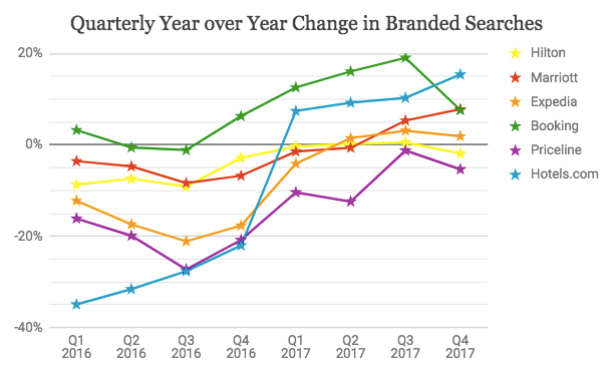
Compiled taking Google Trends daily data, taking the average for a given quarter, and then doing a year over year % change.

The graph above shows the percentage change in branded searches from Quarter 1 of 2016 to Quarter 4 of 2017. The reason this graph is included is to highlight the preferences of consumers when booking hotels. As can be seen above, hotels such as Hilton and Marriott have been operating at a negative percentage change or barely positive. This means that customers are opting less to book hotel rooms using individual hotel websites. On the other hand, hotel booking OTAs have either an averagely increasing percentage change of branded searches or in the case of Booking.com have increased branded searches in all but two quarters (Q2, 2016 and Q3, 2016).

Relating this back to Malaysia, the tourism industry contributes to a relatively large part of Malaysia’s growth contributing to roughly 5.9% of Malaysia’s GDP in 2018. Since the early 21st century, Malaysia has put a relatively high significance on this Industry and this has led to an Increase In foreign exchange earnings from RM17.3 bn in 2000, to RM46.1 bn in 2007 (BNM, 2008). This increase has largely been due to the effects of campaigns such as ‘Visit Malaysia Year’ and “Cuti-cuti Malaysia’. This increase in tourism has led to many spillover effects into other industries including the hotel industry. This has also meant that during these times. OTAs in the hotel booking industry was able to grow at extremely fast rates and expand across Malaysia and other South-East Asian countries who also had increases in tourism, like Thailand and Vietnam.

Agoda – Business Model and Revenue Model

Agoda Business Model

Most OTAs employ a variation of the commission-based marketplace business model. This is where they charge a commission from each transaction. Then a customer pays a provider, the platform facilitates this payment and charges either a percentage or a flat fee. In the case of OTAs, this is usually a percentage fee.

The biggest challenge of the marketplace business model is providing value to both the customers and the providers (hotels). If the customers do not find enough value from the platform, they will go directly to the providers (hotels). On the other hand, if the suppliers (hotels) do not gain value from the platform, they will be better off operating individually than listing their supplies on the platform. This highlights a key limitation in the Agoda business model.

OTAs mainly utilise three main business models: advertising, agency and marketplace business model. Although sounding seemingly confusing and technical at first, the OTAs are generally demanding aggregation platforms. These types of businesses perform extremely well in highly fragmented industries, in which many companies compete and there is no single company which dominates the industry. These comparisons will be drawn and illustrated in greater detail in the section further below: Competitors.

Agoda utilises the marketplace business model to make all of its revenue. As mentioned above, this essentially means that they act as a third party agent which resell trips, hotels, vacation packages, etc, where the guest pays off the OTA at the time of booking, and the OTA will only pay the hotel after the actual stay occurs. For the sake of clarity, below is an example of the marketplace business model in action where the OTA platform buys hotel rooms and then resells them to travellers.

Example:
“Agoda wants to offer a 2 week, all-inclusive vacation for two in Malaysia. Ago& contacts a Hilton PJ and asks to buy a block of 80 rooms at RM50 a piece instead of their Best Available Rate of RM90. Agoda then contacts AirAsia and makes 160 seat reservations to Malaysia for RM600. Assuming that there is no discount included, the package is offered to guests from outside Malaysia for RM1700 for two people. Customers on Agoda buying this package get the benefit of having saved RM130; Agoda shareholders get the benefit of only paying RM1550 for a package that they would then sell to the 80 couples for RM1700.”

This model allows for Agoda to remain cash flow advantageous, as they can get the cash upfront from the customer at the time of booking which is usually in advance of the actual travel itself. This is one of the major strengths of the Agoda business model.

However, this does not mean that the marketplace model restricts individual hotel bookings. II means that the marketplace model usually allows for package deals which will appeal even higher to customers who do not want to or lack the necessary skills to research flights, accommodation and other things included in the vacation packages. Therefore, it has been seen that Agoda offers both hotel packages and individual hotel bookings. This highlights the effectiveness of the Agoda business model.

Delving deeper into the nitty-gritty details of Agoda’s business model, they are constantly looking for ways to improve their business. As a subsidiary of Booking Holdings, Agoda is one of the smaller players in the hotel booking business, as compared to the larger key players: Booking Holdings and Expedia. Therefore, their acquisitions are usually centred around improving operational efficiency and refining their business model rather than growing their presence in the hotel booking industry. This can be seen in Agoda’s 2014 acquisition of Qlika to focus on pay-per-click advertising and improving their marketing and Agoda’s 2016 acquisition of WooMoo to focus on their mobile app development. This allows Agoda to continually improve without refining the Agoda business model too much.

A bigger, key player such as Expedia, however, has been seen to acquire other smaller players in the hotel booking business to increase their reach in the industry. This was seen in 2012 when they acquired the Via Travel, the largest travel company in Norway and in 2014 when they acquired Wotif.com, one of the key players in Australia’s hotel booking business.

Agoda has also been seen to branch out into other OTA subindustries such as non-hotel accommodations in 2017 and selling flights in 2019. In terms of the new app and website initiatives, they introduced the ‘Mix and Save feature in 2019, which essentially allows customers to book a different room for every night of the stay to allow for the cheapest deal and also the ‘AgodaCash’ initiative which allows customers to earn AgodaCash which works as an instant discount on their future bookings, limited to the amount of AgodaCash the customers earned.

Agoda business model

Fee Revenue Model

The transaction fee revenue model is where a company receive commissions based on volume for enabling or executing transactions. The revenue is generated through transaction fees by the customer paying a fee for a transaction to the operator of the platform. In the case of Agoda, Agoda is a market place operator which provides customers with a platform to place their transactions. During this process, the ‘customer can be presented as both the buyer or the seller. To participate in this market place, ‘customers’ must first register into the platform so both parties of the transaction can be identified. The amount of the transaction fees are then seen as revenue generation by the platform. The fees can be either fixed or percentage, but in the case of Agoda are usually percentage calculated.


Taking the Agoda/Malaysia example above, it can be seen that Agoda generate revenue directly from the customers who pay them the cash upfront after buying a certain package or individual hotel bookings. Agoda also gains revenue from the commission which is paid by the hotels for bringing customers to their hotel.

Agoda Business Model Canvas

Agoda business model canvas

Who are Agoda’s Key Partners?

1)Travel service providers:

  • Hotel owners
  • Non-hotel accommodation owners
  • Airlines
  • Rental cars
  • Activities Providers

2) Offline travel agency affiliates

  • These agents earn at a commission rate of 5%

3) Corporate travel managers: Agoda has a more ambitious approach to corporate travel management than Booking.com, as they even have their own business travel management portal YCS that leverages off supply-side partners.

4) Technology partners: Agoda Invests a lot into its tech. From Improving Its online marketing through the acquisition of Qlika and the acquisition of WooMoo to improve their mobile application prototyping, they have even been seen to employ the entire WooMoo team to Join their Bangkok headquarter to work on mobile app development.

What are Agoda’s Key Activities?

Agoda’s key activities are mainly based on customer experience. For example, Agoda enhances the positive indirect network effects and customer experience by increasing and improving on the number of bookable accommodations (by increasing number of locations), types of bookable properties (by including non. hotel accommodations) and improving accessibility to older age groups by making the platform more user-friendly.

Agoda also constantly refines its technology to improve accessibility and also ‘cc increase their reach into the consumer base. This can be done through upgrading their website and their app based on the available data and evolving technology, trends and feedback. This can also involve stimulating demand through refined marketing, for example, by using promotions or notifications to inform customers. This will then lead to an increase in engagement rate and conversion rate.

Agoda also observes external factors to ensure they can match changes in different situations and environments. For example, they may observe the regulatory landscape of different countries to ensure they are under compliance and avoid unnecessary fines. Furthermore, they may also observe and study the industry landscape in itself to look out for new entrants and do the same to other OTA subindustries to learn about new or potentially disruptive approaches.

What practical resources does Agoda need to operate?

The key resources that Agoda utilises are to optimise the hotel and traveller experience. Therefore, the number of hotels and quality of hotels will influence customer decisions and a small number of hotels may mean that customers go to a different platform or competitor which offers a greater variety of hotels, which also increases the probability of having a lower-priced hotel.

Furthermore, understanding user data and user experience will allow Agoda to make more informed decisions and serve their customers to a more satisfactory standard as they understand what customers are looking for. The key resource of skilled staff is especially important as it allows Agoda to continually improve and allow it to continue competing with other players in the hotel booking business.

What value does Agoda create for their customers?

The value that Agoda offers differs between travellers and hotels.


For travellers: Agoda gives value to travellers by providing choice and variety, price, user experience standpoint and higher value packages. Essentially, this allows travellers to improve their travel experience and gain better value when travelling.


For hotels: Agoda gives value to hotels by reducing the need for hotels to incur an administrative cost when dealing with customers during the process of hotel booking, allows for an increased flow of customers, links hotels to the global customer base, brings in additional web traffic by introducing travellers to holey which they may not have heard of before and also bring in higher market information to hotels themselves which can then be used to create a more optimal pricing strategy.

How does Agoda interact with their customers?

Agoda has two main customer segments: travellers and hotels. The customer relationship between these two segments can be seen as relative opposites. The reason being that for travellers, Agoda uses a very friendly and personalised approach as they ensure that customer service is guaranteed and they are accurate in delivering their services to travellers. On the other hand, hotels and OTAs such as Agoda have a love-hate relationship.

This is because although they do bring value to hotels, Agoda and other OTA’s market concentration gives the OTAs more pricing power, which results in rising commissions which means that hotels earn less from their bookings. A study by Kalibri Labs data has even shown that commissions have jumped 45% as a share of guest paid revenue since 2015. Furthermore, Agoda’s lenient cancellation policies lead to hotels facing high cancellation rates which may depress revenue.

Hence, hotels are aggressively promoting their loyalty programs to achieve higher levels of direct bookings to avoid paying commissions to the OTAs. These can be seen in loyalty benefits such as free amenities like WiFi or an exclusive massage session. However, Agoda is also running its own loyalty programs to promote bookings using their system. This can be seen in the ‘AgodaCash’ program which encourages the use of the Agoda system.

Therefore, although the relationship between Agoda and the hotels are usually mutually beneficial, as Agoda continues to steal even more bookings from direct bookings to the hotels, hotels may start to employ more aggressive customer acquisition strategies.

How does Agoda inform customers about their value proposition?

Agoda’s channels are their website and their app. Therefore, Agoda usually focuses a lot of their resources on bringing customers to their app. This can be seen in the fact that Agoda has spent a lot of its resources on improving their marketing and spending on advertising.

Another channel that Agoda uses is their ad channel. In terms of ad channels, this can be seen in the fact that Agoda has paid advertising on Google and Bing and has also attempted to improve their organic search ranking by publishing useful content for travellers. Agoda also posts ads on other OTAs to try and steal customers, and in return, the other OTAs receive ad revenue. Lastly, they also go through other ad channels such as metasearch engines like Trivago.com and Google Hotel Ads.

Which groups of people are Agoda solving the problem for?

Agoda’s main customer segments are travellers and hotels. Due to the increase in globalisation and vacations abroad over the past few decades, this has greatly benefited Agoda. With many people coming out of poverty and having the ability to travel, Agoda’s customer segments will continue to grow.

Hotels are another customer segment and new hotels will usually immediately register with Agoda or other OTA to get customers faster.

What are the type of costs Agoda incurs?

Agoda’s main costs can be divided into two categories: operating expenses and capitalised cost. Although there is not much information on the exact cost values of Agoda, we can extrapolate the rough percentages based on Expedia, another OTA which utilises the marketplace model.

Operating Expenses

1) Selling and Marketing (50.8% of revenue)

  • Direct costs (80% of Sales and Marketing)
    • Cost of advertising on search engines and other websites
    • Private label and affiliate program commissions
    • PR and other costs
  • Indirect costs (20% of Sales and Marketing)
    • Personnel overhead and stock-based compensation

2) Costs of Revenue (17.9% of revenue)

  • Customer operations
  • Credit card processing

3) Technology and content (14.6% of revenue)

  • Personnel and overhead
  • Depreciation and amortisation of technology assets

4) General and administrative (7.0% of revenue)

Capitalised cost makes up the other categories of costs for Agoda. This can be divided into three different sections: property and equipment, intangible assets and goodwill. Unlike operating expenses, this should not be extrapolated as different OTAs’ balance sheets usually look quite different on the technology-related assets. For example, Priceline has much higher asset values in property and equipment, similar in intangible assets and significantly higher in goodwill than Expedia.

As Agoda is a subsidiary of Booking.com, they are not legally required to publish their annual reports. Therefore, there is no way of finding the exact operating expenses of Agoda. The figures in the ‘Operating Expenses’ subsection are actually based off Expedia. The reason we chose Expedia is because Expedia also utilises the merchant business model and therefore will have the most similar operating expenses as Agoda. These figures were obtained from page F-4 of Expedia’s 2019 annual report.

How does Agoda generate revenue?

Agoda’s marketplace business model brings in the revenue into the company. According to Skift data, this model brought in $1.2 bn in 2017 alone. Agoda generates revenue directly from the customers who pay them the cash upfront after buying a certain package or individual hotel bookings. Agoda also gains revenue from the commission which is paid by the hotels for bringing customers to their hotel.

Competitors
Agoda business model
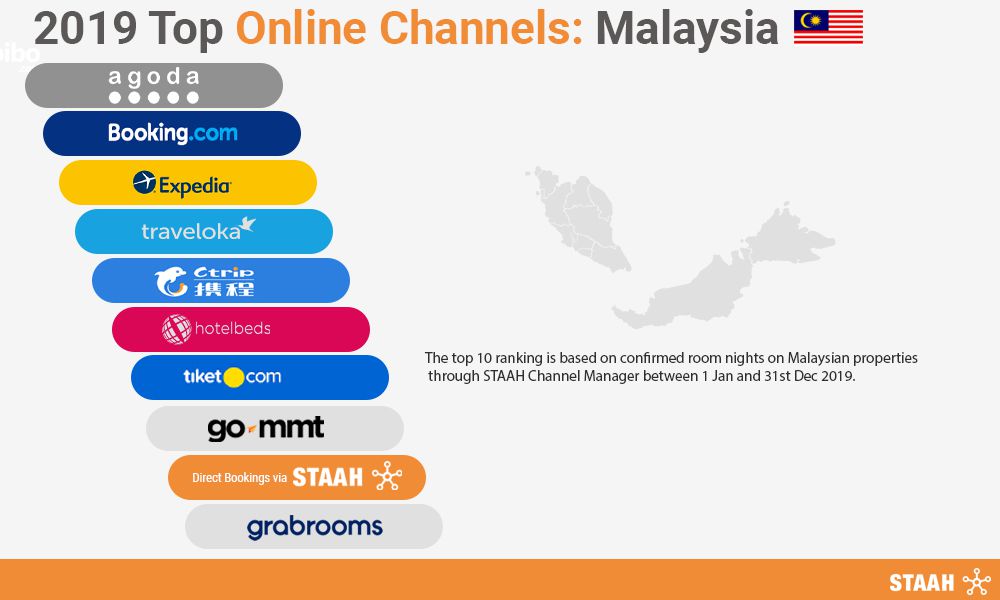
Statistics obtained from STAAH Channel on Malaysian Top Online Channels in 2019

As can be seen in the figure above, Agoda is the highest-ranked based on confirmed room nights booked on Malaysian properties between 1 January and 30 June 2019. Agoda’s main competitors right now are Booking.com, Expedia and Traveloka. The interesting aspect of OTAs as compared to firms in many other industries is that there are three different business models which OTAs employ, and there are even OTAs which employ all three.

Booking.com (Agency Business Model)

Agoda business model

Booking.com is an OTA wholly owned by the Priceline Group, with a market cap around $99bn and annual revenue of —$11bn. Although Booking.com does employ the agency business model and also have other revenues from advertising, 75% of its revenue comes from the agency business model.

This means that Booking.com’s revenue model is the same as that of the brick-and-mortar travel agency and is therefore based on commissions. This means that Booking.com uses the contracts that it signs with hotels that it lists on its websites and will take a commission bade on each booking made by customers through its website, usually between 10% to 30%.

Although seemingly a large range of commission, Booking.com negotiates commissions based on the size of the hotel and how well the respective hotel ranks in its platform. The advantage of this as compared to other business models is that by offering hotel rooms on a commission basis, there is the benefit of not owning the hotel rooms and therefore not having cash and carrying unsold inventory risk.

The agency business model also puts Booking.com at a severe advantage compared to individual hotels. To put into context, studies show that most people use the same hotel either only once or a few times in their life. This is especially true for smaller, independent hotels. OTAs, on the other hand, do not need to worry about which of their hotels the user books, as they make commission either way.

Hence, they can pay much more on advertising than any individual hotel or even larger hotels like Marriott can pay. This is further illustrated in Booking.com’s 2015 annual report which states that it spent $2.7bn in 2015 and an additional $273m for brand advertising. From a microeconomics point of view, this means that Booking.com can apply massive advertising economies of scale in their customer acquisition as compared to individual hotel chains.

In terms of technological investments, Booking.com is at the forefront of the OTA industry, investing upwards of $100m every single year to further enhance their technology.

Agoda business model

This allows for Booking.com to provide an amazing user experience and provide a deep infrastructure which links the vast array of hotel distribution systems. Looking at the picture above, these features on the Booking.com website have been refined for years and is still now being improved to invoke emotional feelings in the customer and encourage a purchase. This allows for OTA to focus more on the actual sale itself as compared to individual hotels which booking page more-or-less merely represent a transaction form.

Expedia.com (Marketplace, Agency, Advertising)

Agoda business model

Expedia.com (not to be confused with Expedia Group who owns Expedia.com) was launched on October 1996 as a division of Microsoft during the dot com hype. Expedia.com went public in 1999 and in 2001 was bought over by USA Networks, Inc.

Agoda business model

Expedia is one of the more unique OTAs as their business model can be separated into:

  • HomeAway: $1.2bn / $11.22bn = 10.4% of revenue
  • Advertising & Medi: $1.9bn / $11.22bn = 9.7% of revenue
  • Marketplace Revenues: $0.57bn / $11.22bn = 53.0% of revenue
  • Agency Revenues: $3.0bn / $11.22bn = 26.8% of revenue

This data was obtained from Expedia’s 2018 annual report. As can be seen, although advertising makes up a huge amount of its revenue, agency revenues and HomeAway revenues also make up quite a large percentage of Expedia’s total revenue. However, as we have discussed all three of advertising, marketplace business model and agency business model, we can draw comparisons between Agoda.com, Expedia.com and Booking.com.

Key Comparisons between Agoda.com, Booking.com and Expedia.com

When drawing comparisons, there are major differences despite all being OTAs with demand aggregator platforms. Firstly, the key difference lies in the different geographic exposures of both companies. Expedia mainly serves customers in the US and derives most of its revenue from the United States whereas Booking Holdings operates mainly in Europe and Agoda operates mainly in Asia.

There is also a difference between companies when employing single or multi-brand approach. Expedia is built around the patchwork of different website properties that it acquired over the years, including Hotels.com and Travelocity. On the other hand, Booking Holdings and Agoda generate most of their revenue from their namesake website platforms.

In the long term, this may impact Expedia’s online business strategy. The reason being that despite Expedia having many other website properties, by having a unified website strategy, this allows for a larger market share than similar websites in the region. As a result, most of Booking.com and Agoda.com’s traffic comes from users who go to the page directly, rather than being directed to it by Google’s search engine. Therefore, Booking and Agoda’s website strategy is a superior business strategy.

Startup Fundamentals

What is the Agoda’s problem statement?

The problem that Agoda is trying to solve is that hotels lose customers due to non-user-friendly booking platforms and customers who want to get better deals and do not want to go through the hassle of comparing different individual hotel bookings. Therefore, the problem statement for Agoda is that they solve price comparisons to allow customers to make the best, most well-informed choices when booking hotel rooms.

According to Agoda’s Founder Michael Kenny, “Agoda’s mission is to make booking hotels in Asia easy and affordable for customers around the globe;’. This is in line with the problem they are trying to solve and to ensure that customers are able to get the best deals they seek and to provide a user-friendly experience.

What is Agoda’s proposed solution to these problems?

Agoda and other OTAs have delivered a very elegant, free-market solution to this problem presented by providing a platform which both hotels and customers can easily access. With Agoda’s online platform, Agoda lists all of the available hotels based on the customer requirements and links these customers directly to hotels. This allows for theoretical effect information which allows customers to make the most informed choices. In return, hotels get an increase in the supply of customers. This especially benefits independent hotels which people may not have heard of before or explicitly search for.

How does Agoda offer such cheap prices?

As mentioned previously, Agoda uses the marketplace model. This means that, in some cases, Agoda can actually buy hotel rooms directly and in bulk, then offer them to customers at extremely competitive prices. This happens a lot with Asian hotels and is also the reason why Agoda is one of the top performing OTAs in Asia and can charge such cheap prices.

Another factor that illustrates Agoda offering such cheap prices is what is known as ‘The Illusion of Choice’ or ‘self-competition’. This is where both Agoda and Booking.com trick people into thinking that both sites are major competitors offering different prices to undercut each other, when in reality it does not matter which company the customers choose to buy from as Booking Holdings, the parent company, ultimately earns all of the money.

What is the hotel booking business market size?

We calculate the market size of hotel booking OTAs in Malaysia by multiplying the number of hotel rooms available in Malaysia each year by the total revenue of hotel rooms per year. Then, we multiply this value by the assumed average of 15% charged as commission from Agoda.

Agoda business model

According to the 2018 Malaysian Hotel Rooms Survey, the total number of available rooms per day is 43,697. By multiplying this by 365 days, we get the total number of available rooms in a year. The data above also shows the total revenue per available room in a year to be RM105,588. By multiplying the total number of available rooms in a year by the total revenue per available room in a year, we get the total potential revenue for all hotel rooms in a year. We multiply this by 0.7, as we assume that the rooms are only going to be booked out for 70% of the year. Therefore, assuming a commission rate of 15% charged by all OTAs, multiplying the total potential revenue for all hotel rooms in a year by the commission rate of 0.15 gives us the market size of the hotel booking OTAs in Malaysia.

Calculations:

Total number of available rooms in a year = 43,697 x 365 = 15,949,405

Total revenue per available room in a year = RM105,588

Total potential revenue for all hotel rooms in a year = RM(105,588 x 15,949,405)

0.7 x Total potential revenue for all hotel rooms in a year = RM1,178,846,042,598

Market size for hotel booking OTAs (assuming commission rate of 15%) = RM1,178,846,042,598 x 0.15 = RM176,826,906,389.70

However, it should be noted that the actual estimation for the Malaysian hotel booking OTA industry is much larger than the figure provided above. For example, by extrapolating using Malaysia’s tourism numbers and multiplying this figure by the total revenue per available room in a year before multiplying by the assumed commission rate of 0.15, this figure is much larger than the previously noted result. However, this market size calculation may not be entirely accurate either. The reason being the only way to get an entirely accurate calculation of the market size of the hotel booking OTA industry is by getting all hotel room numbers in major countries where the OTAs operate in.

How does Agoda make money?

In Booking.com’s 2019 annual report, it is stated that it gained $25.79bn that year. As Agoda utilises only marketplace model for the Agoda business model and the only other subsidiary of Booking.com, (Priceline) which utilities marketplace model has only 18% of its revenue gained from the marketplace model, we can safely predict the revenue of Agoda to be at least $15bn.

As previously stated, Agoda’s revenue is derived from customers who pay them the cash upfront after buying a certain package or place a hotel booking and the commission it gains from the hotel when customers book rooms or packages through Agoda’s platform.

Is Agoda a profitable company?

According to Hughes of Agoda, “Agoda is a highly profitable company”, especially in the Asian landscape. He continues, “That may not seem like much to say in the US or Europe. But to be a profitable e-commerce company in Asia is actually astounding”. Agoda has generated a rough estimation of $1.2bn in revenue in 2017 alone and is still growing year-on-year.

As discussed throughout the article, Agoda’s extremely low relative cost and utilisation of the marketplace business model makes it an extremely profitable company. As a reminder, profit is the difference between revenue and costs. In terms of revenue, Agoda’s year-on-year estimated revenue increases by a few million dollars every year. This shows a high revenue company which has high, consistent growth in revenue every year.

Furthermore, their low relative costs are due to their utilisation of the marketplace business model. This, essentially, means that Agoda does not have to spend on hotels, a large number of staffs to run the hotels and other staff to run their business. Agoda’s cost is usually based purely on their marketing and platform enhancements. This means that even if Agoda is suffering from slower revenue growth in a year and struggling to break even for that year, Agoda can easily cut marketing cost to maintain a healthy revenue, and therefore profit, for that year.

This shows Agoda to be a highly profitable company.

What makes Agoda unique relative to its competitors?

Agoda’s competitive advantage is that as a subsidiary, it does not usually focus acquisitions on other OTAs but on improving its own platform. This allows for an increased value proposition to customers. Furthermore, as described before its single brand approach allows for strong web strategies in which it garners a higher number of web visits. Agoda’s reward scheme ‘AgodaPay’ can be used a: hotel points as well as airplane points. Its strong presence in Asia also makes it more competitive in Malaysia as it means that it is covered more on the news and appears more on searches due to their strong geographical advantage.

What is Agoda Cash?

Agoda Cash is a rewards scheme by Agoda, to compete against the rise in rewards scheme made by individual hotels. As compared to other OTAs, Agoda Cash is usually considered to be the simplest travel rewards program in the hotel booking business. This is largely due to their customer-friendly rewards scheme approach in which there are no complex point system, no restriction or spending and no membership requirements. All the customer has to do is book a listed accommodation which has the Agoda Cash badge on it.

Can Agoda continue operating at a high growth rate?

Agoda has been seen to be very scalable. This is mainly due to Agoda’s utilisation of the marketplace business model which allows them to incur very low labour costs, especially as they do not need to hire as many support staff, and can spend more on their marketing to grow their business, as compared t( hotels which have to spend on physical assets such as land, building and staff whilst also spending on marketing to compete with Agoda and the other OTAs This also links to the fact that Agoda’s scalability is strongly tied to its marketing success and spending. This is evident in Agoda’s acquisition of Digitas in September 2019 to improve its data-driven marketing.

Agoda and many other OTAs are reliant on customer acquisition on its scalability. This means the more the available customers, the better Agoda will scale. Therefore, this is somewhat dependent on the state of the economy as well, as better consumer confidence will usually mean a higher number of available customers. Another way they can expand and scale is by reaching other countries and locations. Due to the fact that Agoda is only more dominant in Asia, they can scale by reaching other continents like America and Europe.

Is Agoda a reputable booking site?

Yes, Agoda is a reputable booking site which has been operating since 2005. As a business which relies on strong customer satisfaction and reviews to legitimise its business, Agoda ensures that it has a strong reputation among its customers. For example, Agoda has a very attractive cancellation policy which states that cancellation requests submitted, prior to the due date noted on your confirmation, will normally be refunded 100% of the cost of their stay.

Agoda does not even charge a processing fee for cancellations. This means that even if a customer does not trust Agoda and chooses to cancel his order, he can do so at any time before the actual stay without incurring any processing fees.

Does Agoda have a strong team?

Agoda’s management is extremely capable and has a long background experience. With the likes of John Brown as their CEO, having joined Agoda back in 2010 and was previously a Principal at Boston Consulting Group in Boston, to the likes of Robert Rosenstein who still runs the company as their chairman, since founding Agoda in 2005, Agoda has an extremely solid management team who ensure that Agoda continues to achieve success.

Even their CTO, Yaron Zeidman has had a long history with Agoda having joined back in 2012 and currently manages a team of over 1,200 people in leading data-driven innovation. Before joining various management-level positions, he was the CTO for Liveperson for two years and the CTO at Kasamba where he was responsible for its research and development group as well as its 15 production operations.

Lastly, their COO, Omro Morgensterm is currently responsible for driving global operations at Agoda. Omri is responsible for driving global operations at Agoda and oversees the Product, Partner Services and Customer Experience Group in his role. As the co-founder and CEO of Qlika, he has been working with Agoda since 2014 when Qlika was acquired by Agoda. Therefore, his loyalty and strong commitment to Agoda is a positive sign for Agoda’s management team.

Agoda has a staff of 5,000 in 30 countries, allowing it to have a stronger reach in these countries and focus more resources into improving Agoda’s reach in these respective regions.

Who is the owner of Agoda?

Agoda was originally co-founded by Michael Kenny and Robert Rosenstein. In 2007, Agoda was acquired by Booking Holdings. Therefore, Agoda is currently owned by Booking Holdings, which also owns Booking.com and Priceline.com.

What is Agoda’s revenue?

What is Agoda’s startup traction?

In the startup world, to have traction is to have a measurable set of customers or users that serves to prove to a potential investor that the startup can meet future benchmarks. In other words, this is when a startup has consistent growth in customers, growth in revenue per customers and a sales channel that is consistently working. Therefore, by this definition, Agoda has been seen to have strong traction. As the fastest-growing digital travel platform and a solid sales channel which is being constantly improved since 2005, Agoda has a consistent year-on-year growth in customers, growth in revenue per customers and a sales channel that has stood the test of time.

Despite the COVID-19 pandemic causing a huge hit on sales, Agoda is still forecasted to have a consistent increase in customers and growth in revenue per customers.

Future of OTA

According to Malaysia’s Ministry of Tourism, the number of hotels in Malaysia grew by twofold from 2,373 in 2009 to 4,750 in 2018. As OTA’s growth is determined by both the number of potential customers and the number of available hotels. This trend is positive towards the growth of OTAs in Malaysia.

Furthermore, as countries around the world become more developed, more people will be able to afford travel and hotel booking and will opt for these options. The age of individual hotel bookings has long passed and OTAs will continue to increase their price-setting powers.


Even with the more isolationist approach of countries like the UK during their Brexit and the recent coronavirus pandemic, there will always be an increase in the demand of hotel rooms and therefore hotel room bookings. Malaysia has always placed a significant prominence on its tourism industry, and with that, there is a growing importance for OTAs in Malaysia.

OTAs will continue to improve their platforms to increase customer satisfaction and acquire companies to help them do so.

Afterthoughts

The strange relationship between hotel chains and OTAs is extremely interesting and entertaining to read and write about. On one hand, hotels greatly benefit from the existing OTAs, especially in the beginning. However, with the greater pricing powers, I can only imagine that the commissions demanded by OTAs will continue to increase, and with that a possibility of hotel chains signing exclusive contracts with certain OTAs.

With the oligopoly which we observe in the OTA industry, I believe that the reason that there will never be any competition regulations enforced on OTAs is that they have a business model which is strongly based on customer acquisition. This means that a high priority of the OTAs is to ensure customer satisfaction. Therefore, most of the burden of the increasing commission lies with the hotel chains and not the customer.

However, we can only make assumptions now on what hotels and OTAs will do in the future. The question is: do you, as entrepreneurs, believe that there is a way that hotels can be more profitable, and how can OTAs prevent this from happening and continue benefiting from their high pricing powers?

Sources

https://www.agoda.com/info/about-agoda.html?cid=1844104

https://www.agoda.com/press/leadership/john-brown?cid=1844104

https://www.agoda.com/press/agoda-fast-facts?cid=1844104

https://hoteltechreport.com/news/direct-bookings-how-successful-have-hotels-been

https://www.prnewswire.com/news-releases/online-accommodation-booking-industry-report-2020-global-market-overview-trends-travel-sales–shares-apps-start-ups-and-more-300988296.html

https://www.orisysinfotech.com/Article_trends-in-the-hotel.php

https://www.hotelnewsresource.com/article106206.html

https://ukdiss.com/examples/hotel-industry-in-malaysia.php

https://innovationtactics.com/business-model-canvas-expedia/

https://innovationtactics.com/business-models-tripadvisor-booking-comexpedia/

https://www.forbes.com/sites/greatspeculations/2019/08/26/booking-holdings-and-expedia-are-both-growing-steadily-but-in-very-different-ways/#761cf73c1f04

https://dashboards.trefis.com/no-login-reguired/pPOckl3C/Booking-Holdings-%26-Expedia-Group%3A-A-Comparative-Profile?fromforbesandarticle=booking-holdings-and-expedia-are-both-growing-steadily-but-in-very-different-ways

For more, check out NEXEA
For Startup Investments check out https://www.nexea.co


source https://www.nexea.co/agoda-business-model/

source https://nexeaaccelerator.blogspot.com/2020/06/agoda-business-and-revenue-model.html

Tuesday, 23 June 2020

Grants for startups in Malaysia

This post first appeared on Grants for startups in Malaysia
For Startup Investments check out https://www.nexea.co

The Startup Grants

Startups could always use government Startup grants or in fact any kind of grants! Who doesn’t want free funding/money? Here is a list of grants in Malaysia, specifically for startups. If you would like to add more information, just comment below!

I hope you find a suitable Startup grant to help you achieve your goals. Do note that most Startup grants have conditions attached, they are there to help Startups spend this free money wisely. It is also to prevent startups from abusing grants. These grants are provided by the government to help local businessmen flourish so that the country’s economy as a whole grows faster. If you are interested

If you already have the grants and want to look for startup investment, you may visit our homepage for more information on our Malaysian Angel Investment network.

NEXEA does not provide any business grants in Malaysia, however, the following grant providers do:

Cradle Fund CIP 500 & Cradle CIP 300

Unfortunately, they have closed their startup grants program.

Update 23/6/2020: Cradle has a new grant!

startup grants malaysia cradle

CIP ACCELERATE 

This Cradle grant is a programme that provides up to RM 2,000,000. The programme caters specifically to deep tech startups. The programme helps startups with proven systems to commercialise there product.

CIP IGNITE

The CIP IGNITE programme gives out a conditional grant and assistance up to RM 500,000 for tech-based startups, local SME’s or spinoff companies from university research.

For more information:

For further enquiries, email us at cip300@cradle.com.my OR call us at 03 – 4045 8600

PlatCom

startup grants malaysia platcom

PlatCom’s website is vague, but, they do provide a matching grant last I checked. It is up to RM1m, and it is on a matching grant basis. To get the grant, you first need outside investors to fund 40% of your fundraising, and PlatCom will chip in the remaining 60%. Note that this fund is not for everyone, as it is limited to certain industries (it includes ICT if you’re a tech startup).

RM1,000,000 Matching Grant

Looking for someone to match this grant with? Let us know! We are an angel investor group looking for great Startups to fund.

Teraju Superb

startup grants malaysia teraju superb

Skim Usahawan Permulaan Bumiputera or SUPERB is an RM100 million grant fund to finance Bumiputera start-ups. Each team of entrepreneurs has to go through a business challenge by pitching their ideas for funding approval. There are 4 application windows throughout the year.

RM500k for Bumiputera Startups

Useful Startup Investment Resources

For more, check out NEXEA
For Startup Investments check out https://www.nexea.co


source https://www.nexea.co/list-of-startup-grants-malaysia/

source https://nexeaaccelerator.blogspot.com/2020/06/grants-for-startups-in-malaysia.html

Tuesday, 16 June 2020

Dahmakan Business Model

This post first appeared on Dahmakan Business Model
For Startup Investments check out https://www.nexea.co

This article is part of a study of popular businesses & their business and revenue models so that people can understand how investors look at startups. Examples of which can be seen in our Grab, Setel and Lazada articles. Most information are facts collected publicly, and some are our own assumptions – which are pointed out as such. In this article, particularly, we will be looking at the Dahmakan business model.

Dahmakan is an innovative start-up that is stirring up the food delivery market in Malaysia. We might think it is another food delivery service. There are plenty of those already. However, Dahmakan differs from its competitors in several significant ways.

Dahmakan, which translated from Malay means “have you eaten?”, offers fresh and healthy meals produced daily in their kitchens by the best chefs.

It is a food delivery service that uses artificial intelligence in logistics and cooking automation. It supplies their customers with daily food requests around Kuala Lumpur, Petaling Jaya and Subang Jaya to Putrajaya and Cyberjaya.

Rather than trying to create another marketplace, Dahmakan’s founders wanted to take control of the entire value chain, including food production and logistics.

The startup combines centralized, large-scale production with collected customer data, machine learning and experienced chefs to offer the best possible experience in food delivery.
It uses artificial intelligence for the delivery to the customer and can, therefore, offer the lowest delivery costs in the industry.

Dahmakan was founded in 2015 and is headquartered in Kuala Lumpur, Malaysia.

It was founded by former executives of Foodpanda and was the first Malaysian start-up company to participate in Y Combinator’s start-up accelerator program.

Dahmakan – History & Facts

  • Where? Kuala Lumpur, Malaysia
  • When? Founded on Nov 17, 2015
  • Latest funding round: Series B
  • Funding status: Early Stage Venture
  • Total Funding Amount: $27M
  • Number of Employees: Around 130
  • Available on the App Store & Google Play
  • Healthy, fresh meals
  • 4.7 on Google rating
  • 125k Instagram followers
  • 200+ corporate partners in KL
  • Over 2 million halal-friendly meals cooked and served
  • Available in Kuala Lumpur & Bangkok

*Note that the statistics used may be slightly dated*

Food Delivery Business in Malaysia – Cloud Kitchen

What are the most common cloud kitchen concepts?

The eServices market segment ‘Online Food Delivery’ includes two different delivery service solutions for ready meals: restaurant-to-consumer delivery and platform-to-consumer delivery.

Revenue includes the Gross Merchandise Value (GMV), which is defined as the total sales dollar value of goods/food products sold through the online food delivery marketplace. The revenue of online food delivery in 2020 is US$192m which means an increase of 32.4% yoy. The number of active users in 2020 is currently 6.2 m users. This means an increase of 23.8% yoy.

The delivery service solution that has generated more revenue in the years from 2017 to 2020 is the Restaurants-to-Consumer delivery. However, it is expected that in the next few years until 2024, platform-to-consumer delivery and restaurant-to-consumer delivery will roughly balance each other out.

Since Pizza Hut launched the very first online ordering of pizza in 1994, online food delivery has become a billion-dollar business.

Although platform-to-consumer delivery companies such as Deliveroo or Uber Eats operate a more cost-intensive business model, these companies have become more important in recent years, especially in densely populated regions such as cities. However, platform-to-consumer delivery companies take care of the entire delivery logistics, which is not the case with restaurant-to-consumer delivery.

Both models are likely to converge with increased competition between in-house and third-party solutions.

Cloud Kitchen is a new concept in the food delivery industry which is very promising. Dahmakan is also a start-up that has adopted the cloud kitchen concept.

There are 6 different Cloud Kitchen concepts.

1. The Independent Cloud Kitchen

  • Single brand, single kitchen, no storefront

This is the original cloud kitchen model. It describes a restaurant without any seating space and any physical storage, so without a storefront. This allows restaurant owners or newcomers to the grocery business to avoid high rents and real estate costs.

2. The Multi-brand Cloud model 

  • Multi-brand (cuisine), single kitchen, multiple outlets, no storefront

The more complex cloud kitchens are based on data intelligence, such as territorial demographics of residents, popular food and hyperlocal demand-supply.

The idea is to satisfy the need for the most ordered kitchen within a radius of 5-6 km with relatively few restaurants serving these dishes. This model is smart because it positions each brand as its own individual business.

And a single shared kitchen keeps operating costs low. This model is very similar to the original cloud kitchen model without a physical shop front. You could think of it as cloud kitchen restaurants with specialized cuisine, owned by the same parent brand and sharing the same kitchen.

3. The Hybrid Cloud Kitchen

  • Single brand, single kitchen, multiple outlets, with a storefront

This type of cloud kitchen is a kind of mashup between a takeaway restaurant and a cloud kitchen. This business model is similar to a cloud kitchen business model in general but has a storefront. This allows customers to go into the restaurant and see how their food is prepared or pick up their food right away. In essence, this model takes advantage of all the operational efficiencies of the cloud kitchen business model, but also has a “real” storefront with customers.

4. Delivery app owned by Cloud Kitchen

  • Aggregator owned, multi (restaurant) brand, rented co-working kitchens, no storefront

This cloud kitchen model often referred to in food industry circles as a “shell”, is an optimally located empty kitchen space with a minimum of infrastructure.

Established, but also new restaurant businesses can rent kitchen space and then use for example Swiggy’s online ordering, delivery fleet and menu intelligence to set up a restaurant.

The restaurant brings the equipment, manpower, raw materials and recipes. Put simply, the restaurant cooks and Swiggy manages the rest.

5. Delivery app owned by full-stack Cloud Kitchen

  • Aggregator owned, multi-restaurant brand, rented kitchens, with a storefront

The Zomato model is based on the idea of rental kitchens, but with built-in kitchen equipment and comprehensive processes. In this model, Zomato shares its expertise in managing the order demand.
Like the Freshmenu model, these cloud kitchens also have a storefront that customers can walk into. This model is a mash-up between a cloud kitchen and a takeaway restaurant, similar to the Freshmenu model, all driven by the insights of Zomato.

6. The fully outsourced Cloud Kitchen

  • Cooking and delivery fully outsourced

This is the last and a relatively new concept in the business model mix of the cloud kitchen. This model provides for complete outsourcing, in which all kitchen and delivery processes are outsourced.
A large part of the kitchen preparation is outsourced and delivered to the start-up kitchen. These chefs can then take care of the final touches, and Kitopi will pick them up again for delivery.

What makes Dahmakan so unique?

“Dahmakan is well-positioned to serve the growing demand for food delivery services in Southeast Asia with its unique, technology-forward approach of taking control of the entire value chain to provide affordable delivery options to SEA’s rising middle class.”

This statement was made by Eric Martineau-Fortin, managing partner of White Star Capital, during a press release regarding the financing of Dahmakan.

Dahmakan seems to be different from its competitors. The startup pays a lot of attention to customer contact and relationship.

The company’s full-stack platform is based on an operating system that controls almost every step of the operation, from recipe development to last-mile delivery, and its cloud kitchens are part of “satellite” hubs located in different cities to be closer to the customer.

Unlike many other delivery services, Dahmakan does create its meals. They offer about 40 options each week from a database of 2,000 dishes, instead of delivering from restaurants.

Other food supply platforms such as UberEats, Deliveroo and Foodpanda act as intermediaries. They collect food from stalls and restaurants and deliver the products to the customers. Dahmakan, on the other hand, delivers food prepared by in-house chefs in a centralised kitchen.

Dahmakan applies AI in logistics and cooking automation to make food delivery affordable for millions of office workers in Southeast Asia. 80% of workflows, including delivery and food production, is automated by AI-supported operating systems and proprietary algorithms.

The company does market research, and analyses customer data (food preferences and spending habits) to create a weekly menu.

This menu is given to the customers and they can determine the appropriate delivery time.

Series B Funding

Dahmakan announced in February 2020 that it had completed a USD 18 million Series B.
The investors include Rakuten Capital, White Star Capital, JAFCO Asia and GEC-KIP Fund, as well as the participation of South Korean food manufacturing app Woowa Brothers and returning investors Partech Partners and Y Combinator.

This brings Dahmakan’s total financing to around USD 28 million. The last financing round was announced in May last year.

Business Model Canvas

What is Dahmakan’s Business Model?

Dahmakan business model
This Business Model is designed by NEXEA and can differ from the original one created by Dahmakan.

Who are Dahmakan’s Key Partners?

Functioning partnerships are essential for a successful business model. For a food delivery service like Dahmakan, which employs its chefs to produce its food, especially farmers are essential partnerships. They can provide the company with fresh ingredients so that the quality of the food is always optimized and generally very high.

It is also important to look for a collaboration with a company that provides kitchen supplies at a good price-quality ratio.

Since customers can also order drinks with their food, partnerships with large beverage companies are also advisable.

However Dahmakan does all steps of the operation themselves, so there is no need for many partnerships.

What are Dahmakan’s Key Activities?

The main activity that needs to be done is creating the app with all its functions to get the business started. Apart from that, the main goal should be to create a customer base to ensure the generation of sales. There are many food delivery services in Malaysia, so this activity can be one of the most challenging. Marketing must be very strong, so people can remember Dahmakan. Last but not least, Dahmakan has to build its partnerships to get their business going. Above all, finding chefs is essential for Dahmakan to be successful in the future.

What value does Dahmakan create for their customers?

Dahmakan’s Business Model conveys many values to its customers.

They offer freshly cooked food from in-house chefs with delivery to the office or your front door at home. The ingredients they use are fresh and sourced from the local area.

Dahmakan promises the highest quality in their food.
It is possible to have your food delivered at any time and save money by placing an order. Especially through a referral program consumers can save money and recommend Dahmakan to their friends and colleagues.

What practical resources does Dahmakan need to operate?

The key resources that should be available for the smooth functioning of the Business are sufficient capital to carry out all the operations, the kitchen supplies and food ingredients. At Dahmakan, the chefs are at the heart of the business. The quality of the food speaks for the image of the company. Also, for the website design and development of the app software engineers are needed.

To be able to run the business smoothly, Dahmakan needs a well-functioning team with employees in all areas such as marketing, logistics, finance etc.

 What are the type of costs Dahmakan incurs?

The operating costs of food producers are notoriously high and reduce profitability. However, Dahmakan is one of several start-ups that use “cloud kitchens” closer to the customer to reduce delivery costs.

Cloud kitchens are very cost-effective and operate with low operating costs.
Compared to a traditional restaurant, a “cloud kitchen” eliminates most of the operating costs. These costs include, for example, renting a larger room, labour costs, costs for decoration and conversion and much more.

Take for example the labour costs, which are approximately 50% of the average monthly income of a restaurant.

On the other hand, a 500 ft² cloud kitchen can efficiently serve the same number of customers as a full 1500 ft² restaurant.

However, capital is still required for the employees, business employees, software engineers, chefs & delivery guys.

Also, the equipment for the Cloudkitchens needs to be provided so that the chefs can prepare their food.

The cloud kitchen concept saves a lot of money compared to a traditional restaurant.

How does Dahmakan generate revenue?

Dahmakan generates its revenue through its self-cooked food and delivery. They do not outsource any of their processes, which keeps the money in the company. Dahmakan also sells additional products, such as soft drinks and the like, which are not produced in-house. However, they do not receive commission revenue like some of their food delivery competitors.

How does Dahmakan interact with their customers?

One of the disadvantages of the model of Cloud Kitchen is that it is more difficult to establish a customer relationship compared to traditional restaurants.

The entire customer communication takes place online. To overcome this deficit Dahmakan has set up a member club for high priority customers.

Additionally, it is possible for Dahmakan customers to set up a prime account with which they can get discounts and that offers other features. To attract new customers, Dahmakan also offers discounts to first time users.

However, if users have any comments or complaints, they can always contact customer service.

This enables Dahmakan to build a good relationship with its users, despite this business model does not make it easy.

How does Dahmakan inform customers about their value proposition?

To order food from Dahmakan as a consumer, the consumer can do so either through the Dahmakan App, available in the App Store and Google Play Store or directly on the website Dahmakan.com.

Dahmakan has also uploaded advertisements online, such as on YouTube, to draw attention to their company and its products. The startup also has an Instagram profile with which they communicate with their customers and publish advertisements.

The channels are primarily used to promote the app and the use of the website to increase the demand for the products.

Which groups of people are Dahmakan solving the problem for?

The customer segment of Dahmakan appears to be pretty wide and versatile.

However, Dahmakan is extremely specialized in office workers to deliver their food directly to the workplace.

Also, millennials, who use their smartphones for almost everything these days, are one of the main customer segments Dahmakan is trying to reach. However, all smartphone users are the target group of the company.

Until now, Dahmakan’s service is only available in the Kuala Lumpur and Bangkok area. However, their service can be extended even more in South East Asia.

Competitors locally and worldwide

Who are Dahmakan’s competitors & how does the company differ from their competition?

It’s easier than ever to have food delivered right to your door, anytime, anywhere. Thanks to all the on-demand delivery applications available today.
All you have to do is download one of the apps for food delivery, make a choice, place an order and pay via your smartphone, pay on delivery or pick up your product on-site and pay for it there.


Consumers and sellers benefit from these apps. However, there is fierce competition worldwide. Which food delivery apps are available in Malaysia but also oversea?

QuickSent

QuickSent is above all a company that focuses on offering halal and pork-free food delivery. The prices depend on the available restaurants. QuickSent offers a variety of Malaysian cuisine. Through the app, you can quickly find vegetarian, pork-free and halal restaurants.

They are serving areas like Taiping in Perak, Sungai Petani in Kedah, Kota Kinabalu in Sabah and more. The team tries to deliver the ordered food in less than an hour. 

The company additionally offers a Quick Grocery delivery service. Also, a quick parcel delivery will be available soon.

Honestbee

Honestbee is another food delivery service on the Malaysian market. The popular platform delivers food to customers living in Kuala Lumpur, Petaling Jaya, Subang Jaya, Puchong. The company plans to expand the delivery space even further. Customers can choose to order on the website or through Honestbee’s app in a variety of restaurants, whether Western, Fusion or Malaysian cuisine.

Foodpanda

Foodpanda is a mobile marketplace for the delivery of food, available in 13 countries worldwide. Foodpanda has mainly focused on the Asia-Pacific region. However, they are also active in Bulgaria and Romania and their headquarters are in Berlin, Germany. The Foodpanda Group is an online food delivery services marketplace with a focus on emerging markets.

The company enables restaurants to be visible in the online and mobile world and provides them with constantly evolving online technologies. For customers, Foodpanda offers the convenience of ordering food online with a wide range of gastronomic choices from which they can choose their favourite meal online or on the app.

Foodpanda is one of the market leaders in the majority of its markets, including India, Russia, Singapore and Hong Kong. The company has developed proprietary software and technology for 38,000 partner restaurants and over six million active users. Also, Foodpanda enables on-time delivery and quality through its proprietary delivery service technology and operational processes – even in complex markets and cities.

Just Eat

Another important player in Europe is the food delivery service ‘Just Eat’. The company was founded in 2001 and now covers more than 82,000 restaurants. In 2017 Just Eat empowered around 21.5M customers, of which 11M were active, ordering more than 170M takeaways everywhere around the world.

Deliveroo

Deliveroo is a start-up whose delivery service is available in over 200 cities. Their headquarters are in London. Deliveroo is the best-known food delivery service in Europe.

It allows customers to order food in restaurant shops that do not have their facilities and charges the customer and the restaurant a fee for this service. Customers are charged according to their order, while restaurants pay a commission.

Deliveroo also offers a reward system to motivate their customers. App usage is high due to the increased number of customers, superior customer value and wider choice of restaurants around the world, making it one of the best apps for ordering food available anywhere in the world.

Even Amazon, the US American e-commerce giant, has invested $575 in Deliveroo.

GrabFood

Who does not know the ride-hailing giant Grab?

It not only offers fast rides but also implemented a food delivery service in Malaysia since 2018. With this service, customers can order their food easily and conveniently to their homes. Grab delivery works perfectly, and customers are credited with points every time they order so that they can receive discounts at a later date.

There is no separate app for GrabFood, which makes the service more comfortable for partner restaurants and delivery partners. Grab has combined all its services in a single app.

GrabFood uses its transport and logistics network to ensure that your food products reach you in the shortest possible time. As far as the choice of food is concerned, it is growing day by day with a large number of food vendors to choose from.

Similar concept as Dahmakan, GrabFood has developed its brand for cloud kitchens, GrabKitchen. With its latest expansion to Indonesia, Thailand and Vietnam, GrabFood now has 20 live kitchens throughout South East Asia.

Grain

Another start-up that tries to make food delivery in South East Asia more efficient through a vertically integrated model & cloud kitchens is called Grain. It is supported by investors like Openspace Ventures, First Gourmet and Singha Ventures.

Grain, based in Singapore, is a food delivery start-up company focused on clean, healthy food. They aim to bring value to customers by improving their lives through meaningful food experiences. Grain’s cloud kitchen model is working with their chefs, menu and delivery team to guarantee the best quality and service for the end consumer.

Both Dahmakan and Grain have established “satellite” hubs that allow them to efficiently provide their services to customers in different parts of the city.

Grab and Grain might be the biggest competition right now in the Malaysian market for the start-up Dahmakan.

It is obvious that as a provider of a food delivery service you have a lot of competition that you have to face. In which aspects Dahmakan distinguishes itself will be further analysed in the Startup Fundamentals.

Startup Fundamentals

What is the Dahmakan’s problem statement

When we talk about the problem with Startup fundamentals, we are talking about the problem that Dahmakan is trying to solve. Dahmakan was introduced to eliminate the pain points of food delivery customers face when ordering meals online to their home or office.

It addresses the problem that it is hard to find healthy meals that are straight delivered to your door for reasonable prices. The customer interaction is completely virtual.

What is Dahmakan’s proposed solution to these problems?

Dahmakan wants to solve this problem with the concept of the ”Cloud Kitchen”. On their website, they offer a variety of dishes that customers can pre-order and have easily delivered to their homes.

A cloud kitchen is a professional kitchen that only produces food for delivery and unlike a traditional restaurant, there is no dedicated dining area where customers can eat.

The customers usually also do not have the possibility to pick up their orders. Usually, the customers do not visit the cloud kitchen either, so it consists of only one area for food preparation, without tables, waiting for areas or service counters.
One could also call this type of business a ghost, virtual, commissary, satellite or dark kitchen.

What is the food delivery industry market size?

As the food delivery industry is relatively new and upcoming, there is little to no statistics on the market size of the industry. Therefore, estimations must be made to gauge the market size of the food delivery industry. The assumptions made here are that the food delivery industry will continue growing at its current rate allowing us to predict at least 10% of Malaysia’s population uses food delivery apps. This is around 3.15 million.

Assuming those active users order 4 meals a month with an average price of RM 15, that would be RM 60 of transactions per customer per month. This would also mean an average yearly revenue of RM720. Therefore, by multiplying 3.15 million by RM720 we get a market size of RM2.268billion. Once again, these are our own estimations and are by no means the actual market size of Malaysia’s food delivery industry. Although, they do give a good representation of the food delivery industry in Malaysia.

What makes Dahmakan unique relative to their competitors?

Dahmakan uses unwanted or unused retail space to prepare meals via digital orders. It can still be difficult to offer niche food to the mass population, especially when the price of the food is an important factor.

Dahmakans’ co-founder Jessica Li makes it clear that the company has found a way to scale food production for thousands of deliveries while maintaining a high level of quality.

According to the co-founder of the startup, the costs are even 30 per cent below comparable restaurant prices. This means that Dahmakan not only offers healthier food than most of its competitors but is also competitive through its prices.

Is Dahmakan able to scale?

The most scalable Business Models are those that are considered as a Software as a Service (SaaS).

Dahmakan is an Application as a Marketplace model. Costs are mainly to maintain tech, gain new customers and pay for the chefs and business employees.

Cloud kitchen, in general, are very cost-effective and operate with low operating costs.
Compared to a traditional restaurant, a “cloud kitchen” eliminates most of the operating costs.

Additionally, the company offers premium accounts and a member club. The member club works as a subscription-based model. For a monthly membership fee of RM29, the customer can order all the Promo meals for RM 9.90, Combos for RM15.90 and the remaining meals for Rm 19.90. The client can save up to 50% on every ordered meal. Additionally, there is no service and delivery charge.

Dahmakan can’t be considered as a highly scalable model because the cost of selling the software is zero. However, the cost of selling meals and delivering it is significantly higher. Therefore, Dahmakan can be considered scalable but not highly scalable.

Does Dahmakan have a strong team?

Who are the founders of Dahmakan & how big is their team?

When determining the team in relation to the Startup Fundamentals, the background experience of the team members is of primary importance. It is also important how many employees a start-up has that are available full-time for the company.

We usually evaluate through interviews to find out about their GRIT, if they have the right attitude, if they work well together and if we believe they can take the company all the way becoming a unicorn. However, in this article, it is not possible as we did not interview the team so we could not evaluate those aspects. 

According to the career site LinkedIn, at the moment around 131 employees are working for Dahmakan. Many of them have prior experience in FinTech companies and/or delivery service companies.

The three founders all have considerable background knowledge, which will help running the company.

Jonathan Weins, a German entrepreneur, is co-founder and CEO of Dahmakan.
After studying at Maastricht University in the Netherlands, LSE and Hong Kong University, he started his career in investment banking in Germany (Deutsche Bank, Leonardo & Co). He then worked for a while in management consulting (McKinsey). He then moved to Hong Kong, where he helped found Foodpanda. He was even named Forbes 30 under 30.

Jessica Li is co-founder and COO of Dahmakan. After graduating from University College London and completing her Masters at New South Wales University, Jessica started her career as a strategy consultant with PWC and was subsequently part of the founding of Foodpanda in Hong Kong.

Christian Edelmann is co-founder and CTO. He graduated from the Technical University of Munich and also studied at the Hong Kong University of Science & Technology. Christian started his career at Capgemini as a project manager in software development. He co-founded two different startups before becoming a software engineer and product manager for Allianz X.

Without having more detailed data about the team, it can be assumed from the information collected that it is a well-functioning startup and the team is committed to its success. This is because, from the data given above, it can be seen that all three founders come from extremely successful academic backgrounds who then developed their careers to an impressive degree.

What is Dahmakan’s revenue?

In terms of revenue traction, doesn’t provide any public figures. However, with the user data found online, one can make some assumptions. According to an article of KrAsia in July 2019, Dahmakan has a total of 500,000 monthly active users in the two cities where it operates.

Assuming those active users order 4 meals a month with an average price of RM 15, that would be RM 60 of transactions per customer per month.

Since Dahmakan does not have to hand over any of the money to third parties as they do not outsource any of their processes, their revenue should be about RM 60 per person per month x 500,000 customers= RM 30,000,000 Sales Revenue/month

As for a full year, we estimate that the sales revenue could be around RM 360 million as of now for Malaysia alone. Of course, these estimated figures will not correspond exactly to reality. However, they will help to draw a big picture, which will help to understand the startup better.

As there are no concrete numbers to be found online, these figures are only simple assumptions to help us understand the business model.

How does Dahmakan make money?

When talking about monetisation in Startup Fundamentals, it means how the business model can be turned profitable when needed and on how high the margins are in a long-term view.

The Cloud Kitchen model is based on the principle that there is no physical restaurant in which guests can sit down and eat. This saves many costs such as for rent, labour costs, furniture, etc.

Since Dahmakan also takes care of the delivery itself, the company reduces delivery costs by not having a third party deliver the food. Cloud Kitchen are very cost-effective and operate with low operating costs.

A restaurant has an average profit margin of 3% while the concept of a cloud kitchen provides a profit margin close to 10%.

Within the different business models for Cloud Kitchen that were already explained in the article, Dahmakan is considered as an independent Cloud Kitchen model.

Dahmakan is Malaysia’s first food delivery app that consists of a single brand, a single kitchen and not a fully integrated business model. Customers place orders online, the in-house chef cooks, and the delivery service delivers the food directly to the customers.

Dahmakan also speaks of a fully integrated model. This model manages the complete food cycle and offers all 3 services without outsourcing – ordering, cooking and delivering.

As the company has been in existence for five years by now, it is safe to assume that it is growing rapidly and Dahmakan is investing in its employees. Employees are in the company’s case the kitchen chefs, delivery guys and business employees.

There is no information available online about how much an employee earns at Dahmakan. Through research on various startups in Malaysia, however, it can be estimated that the average salary is around RM 4,500. The average salary for a delivery driver in Malaysia is RM2457 and the average kitchen helper salary is RM1553. A business employee working in a startup earns around RM5000. All those numbers are again assumptions made by NEXEA to draw the bigger picture.

It is also unclear whether all employees of Dahmakan are registered on LinkedIn. However, we now assume a number of 130 employees that are registered on LinkedIn, who earn an average salary of RM 4,500. With these figures, it is now possible to calculate the costs that Dahmakan pays to its employees every year. 130 employees x RM 4,500 x 12 months result in RM 7,020,000.

The above excludes other costs like office expenses, marketing costs, sales costs, and so on. Let’s say, these add up to 30% of the estimated revenues above, which is typical of high growth companies which are RM 120m (360m/3). So we can calculate their rough profitability: RM360m – RM120m – RM7,02m = RM232,98m. Therefore, we can assume that Dahmakan may be already making money.

These numbers do not correspond to reality and are assumptions that Nexea has made through online research and own experiences. Online there are no exact figures to be found about Dahmakan.

Future of Dahmakan – Cloud kitchen

Cloud kitchen, a new concept has entered the food industry from the back door. The number of investors supporting start-ups of cloud kitchens has increased considerably in recent years.

Cloud kitchens are a growing phenomenon in Malaysia but also around the world as consumers are increasingly deciding to eat in rather than out in restaurants. The Cloud Kitchen model has evolved to take advantage of this demand without the extra cost of traditional take-out or meal-in services.

Reports indicate that the cloud kitchen concept is gaining ground with the highest CAGR among other segments of the hospitality industry.

There is a huge potential for the cloud kitchen business, even if this does not mean the end of restaurants or retail. The biggest winners will be start-ups that want to enter the restaurant business with lower overhead costs.

Afterthoughts

There are several advantages to the usage of a cloud kitchen. The biggest benefit is that it can dramatically reduce costs for businesses as cloud kitchens eliminate the need for dining rooms and service personnel.

As the restaurant sector is considered a very risky sector, cloud kitchens are a major advantage in this industry. Many companies fail within the first year in this sector. But cloud kitchens are not bound to the same risk, because aspects such as location, investment in real estate or even the purchase of special equipment, e.g chairs, desks for a restaurant, are not necessary. Cloud kitchen can be operated from anywhere.

Also, greater efficiency can be generated because the sales process and service remain in the background and the quality of the food in the foreground.

However, this sector not only provides an advantage. For example, low costs and flexibility can also be a challenge for a start-up.
Companies using this model may face a degree of mistrust or prejudice because some people see them as a threat to traditional businesses. There may also be concerns about how well these kitchens are regulated.

Creating a reliable brand is essential when your customers are unable to visit your premises. Building good customer relationships through social media can sometimes be a challenge. Establishing a customer-friendly system for complaints and reviews can make all the difference.
With the right technology to manage sales and communications, the cloud kitchen model can be a huge success for you while providing your customers with a service they love.

There is a huge opportunity for the cloud kitchen business, even if this does not automatically mean the end of restaurants or retail as we know it. The biggest winners will be start-ups that want to enter the restaurant business with lower overhead costs.

Sources

https://www.statista.com/outlook/374/122/online-food-delivery/malaysia#market-globalRevenue

https://www.adroitmarketresearch.com/industry-reports/malaysia-online-food-delivery-market

https://www.gruenderszene.de/datenbank/unternehmen/foodpanda

https://www.netsolutions.com/insights/top-10-successful-food-delivery-apps-in-the-world/

https://www.evonomie.net/2020/01/14/digital-marketing/benefits-of-the-cloud-kitchen-model-for-businesses/

https://www.sphinx-solution.com/blog/how-to-make-a-successful-food-ordering-app-like-dahmakan/

https://www.crunchbase.com/organization/dah-makan#section-funding-rounds

https://yourstory.com/mystory/cloud-kitchen-new-future-food-industry

https://kr-asia.com/jessica-li-of-dahmakan-on-disrupting-southeast-asias-food-industry-women-in-tech

https://partechpartners.com/companies/dahmakan/

Dahmakan, a Malaysian ‘full-stack’ food delivery startup, raises $18M Series B
Dahmakan- Malasiya’s Leading Cloud-Kitchen Startup
The 6 Cloud Kitchen Business Models and How They Work

https://theaseanpost.com/article/cloud-kitchens-serving-healthy-options

https://www.statista.com/statistics/1078732/cloud-kitchen-market-size-us/

https://help.dahmakan.com/support/solutions/articles/44001789837-what-s-dahmakan-select-

https://www.michaelpage.com.my/sites/michaelpage.com.my/files/16777_mp_my_salary_benchmark_2020_all_web_v2.pdf

http://www.fnbnews.com/Top-News/cloud-kitchens-and-profitability-in-the-online-food-delivery-platform-5345

For more, check out NEXEA
For Startup Investments check out https://www.nexea.co


source https://www.nexea.co/dahmakan-business-model/

source https://nexeaaccelerator.blogspot.com/2020/06/dahmakan-business-model.html

Saturday, 30 May 2020

Startup Survival Rate – Success & Failure Statistics

Every year, thousands of ambitious entrepreneurs start their own businesses. They are motivated, have hope, and look positively into the future. But especially in times of crisis, it is hard to stay alive as a start-up. How many startups on average manage to become successful, and how can they best prepare themselves against crises to survive them, and even leave the situation stronger than before?

Is it Hard to Survive?

What the expert’s outline is far from quick answers and makes it clear that companies and people do not so much learn from mistakes, but rather get to know themselves better through the errors they make. Failure is the occasion to look at oneself and to define goals more precisely. The creation during these processes is called mindful organisation.

Around 50 per cent of all start-ups fail within five years, it is presumed, and even that is still comparatively good compared to the fate of ideas. Data-based companies such as Google or Facebook test almost all suggestions for improvements to their websites in so-called A/B tests: They show randomly selected users the innovations and measure whether they are clicked on more often or used more intensively than the previous pages. The result of hundreds of thousands of such tests: Around 90 per cent of all new ideas are worse than what is already there.

Top 10 Success & Failure Startup Statistics at a glance

  • 20% of startups fail within the first year
  • over 50% of startups fail after 5 years
  • over 70% of startups fail after 10 years
  • a third of small businesses get started with less than $5,000 USD
  • 58% of startups get started with less than $25,000 UDS
  • 40% of startups are profitable
  • 30% of startups are break-even
  • 30% are continually losing money
  • 82% of businesses fail because of cash flow problems
  • $10,000 is the average amount of startup capital required by a small business owner

*The data are surveys from other articles and refer to startups from the US market. However, the % values do not differ significantly worldwide.

It all seems very negative at this point. But never let that discourage you as a founder. There are several factors that speak for the success of any start-up. Bill Gross, an American investor, fund manager, and philanthropist, describes in one of his TED, talks about the factors that lead to startup success. According to Bill, after reviewing hundreds of companies, he created an image on how to assure success for your startup.

1. Funding

You might think that the amount of funding has everything to do with the success of a start-up. But according to Bill Gross, this is not a direct indicator of success. Nevertheless, startups that received funding have a higher success ratio than non-funded startups.

Well-funded companies accounted for a success ratio of 14%.

2. Business Model

Although a business model is a clear advantage when establishing a company, it can be done without it. YouTube is the best example of this as they didn’t have a business model in the beginning. However, it can only be an advantage for a start-up to create a business model, as the company must have a clear path to follow to generate revenues.

Having a clear structure in the company can more easily lead to later success and according to Bill has a success ratio of 24%

3. Ideas

The very name of his own brand ‘Idealab’ shows how much Bill loves big ideas. Having the right idea and the “ah-ha” moment, leads, according to Bill, to a success ratio of 28% for start-up success.

4. Team

A well-functioning team is essential, not only for a start-up but also for established companies. Especially in crisis situations, but also in everyday working life, the founder must be able to trust his team completely. In his TED talk Bill quotes Mike Tyson who said: “Everyone has a plan until they get punched in the face.” A good team is able to adapt to the true reality of a demanding customer. So maybe Bill views the team as the crucial point for the success of the startup.

Although team is one of the significant factors in the success of a start-up, according to Bill’s studies it has a 32% success ratio.

5. Timing

‘The idea matters a lot. But timing matters more.‘

With a staggering 42% of the difference between success and failure, timing is the winner. As an example, Bill observed that many investors gave up on AirBNB because most of them thought it was strange for a person to rent a room in their house to a stranger.
Apart from a great business model and a great team, AirBNB had the timing on its side. It was created during the recession when people needed extra money. The right timing made AirBNB as successful as it is nowadays.

Not only AirBnb profited from the perfect timing but also the worldwide known company Uber benefited from the recession. The drivers were seeking some extra money to increase their income.

However, there is no recipe to guarantee success for a start-up but these 5 factors can help your startup to grow and become more profitable.

How to Overcome a Crisis

Start-ups often not only have to face the competition and everyday pressure but also have to survive in times of crisis and make the best out of the situation. This can often be very challenging and nerve-wracking. However, the crisis can be an opportunity for some companies in the medium or long term, from which the stronger start-ups can benefit. During the dot.com crash in 2000 and again in 2008, many of the world’s market leaders such as Google, Amazon, and Salesforce grew as startups and benefited extremely from the crisis.

The aim of any crisis management is to preserve the company. In general, early action is the most essential instrument of crisis management. Even the first signs, such as declining sales or liquidity bottlenecks, must be taken seriously. Professional crisis management is often only possible with external experts. However, every company can also carry out crisis management itself and adapt to the respective crisis in the best possible way.

Here are three tips on how your start-up can survive a crisis or even profit from it:

Time for Innovation

It is important that your team and your business does not freeze during this time. It is not the time to simply continue doing the same monotonous tasks every day. You need to be creative and think outside the box. Don’t be afraid to deviate from your original business plan. Gather your team and brainstorm your ideas.

Observe Customer Needs

Customer needs will always change during a crisis, and as a start-up, you have to keep up with the trend. This aspect is linked to the previous one, innovation. Try to find solutions with your team not to lose your customers and in the best case to expand your customer base. As an entrepreneur, it is your responsibility to minimise operational errors and to approach new challenges. Time management, in particular, plays a major role in achieving a change like your enterprise, if necessary.

Have a close look at your finances

The number one priority of every founder must be to avoid that the company runs out of money. In a crisis, many founders are afraid of losing their start-ups. Explore the areas where liquidity can be maintained. Use government programs to mitigate the financial impact of the crisis. Explore short-term working and try to start negotiations on the next financing round. However, if you don’t see any other possibility, you might consider downsizing your team. Instead, many startups choose to work fewer days, reducing labor costs so that they don’t have to spend more resources on hiring to rebuild the team after the crisis.

Conclusion

In conclusion, it can be noted that you should take advantage of the opportunities that arise and be prepared to adapt your product to the evolving requirements to assure your startups’ survival. Use these chances not only to achieve incremental growth but also to strengthen your brand and reputation.

Sources

https://www.entrepreneur.com/article/288769 https://www.zeit.de/2014/01/scheitern-misserfolg/seite-3 https://www.fundera.com/blog/small-business-statistics https://smallbiztrends.com/2019/03/startup-statistics-small-business.html https://www.eu-startups.com/2020/04/5-tips-on-surviving-the-pandemic-from-europes-startups/ https://go.forrester.com/blogs/the-coronavirus-crisis-survival-kit-for-startup-entrepreneurs/ https://www.inc.com/chris-dessi/this-ted-talk-explains-the-5-reasons-why-startups-succeed.html https://www.forbes.com/sites/allbusiness/2020/03/28/coronavirus-crisis-advice-venture-capitalists-giving-startups/#7641ae2f5a3a

This post first appeared on Startup Survival Rate – Success & Failure Statistics
For more, check out NEXEA


source https://www.nexea.co/startup-survival-rate-success-failure-statistics/

source https://nexeaaccelerator.blogspot.com/2020/05/startup-survival-rate-success-failure.html